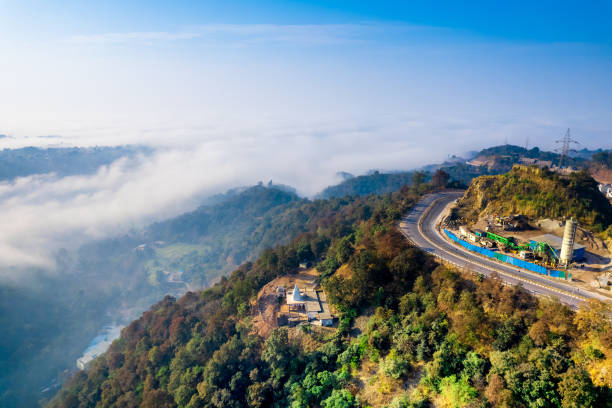
The road from Chandigarh to Shimla is one of those drives that people describe with a particular tone — not quite nostalgia, not quite excitement, something between the two. It’s the moment when the Punjab plains give way to the Shivalik foothills, when the air temperature drops a few degrees and pine trees begin replacing eucalyptus, and when you realise that Shimla — the Queen of Hills, the old summer capital of British India — is about to reveal itself on a ridge ahead of you.
It’s only about 115 km. But it takes 3-4 hours, because these are mountain kilometres, and every one of them is worth it.
Distance and Travel Time
Chandigarh to Shimla road distance: approximately 112-120 km (slightly different by route).
Air distance (straight line): about 56-60 km — the road nearly doubles this because it climbs through mountain terrain.
Altitude change: From about 340 metres above sea level in Chandigarh to 2,200 metres in Shimla. That’s nearly 1,900 metres of gain in about 115 km of road.
Typical travel time: 3-4 hours by car or taxi in good conditions. Budget 4-5 hours if you’re stopping for photos, breakfast, or Solan’s famous dhabas.
Route Options
Route 1 — Via Kalka and Solan (Most Popular): Chandigarh → Panchkula → Kalka → Dharampur → Solan → Shoghi → Shimla. Distance: ~115-120 km. This is NH-5 and the most straightforward route. Well-maintained, regular petrol pumps and eateries, and the route through Solan (Himachal Pradesh’s industrial town) leads quickly into mountain character. A brief detour through Parwanoo adds the famous Timber Trail cable car experience.
Route 2 — Via Nalagarh and Bilaspur (Scenic Alternative): Chandigarh → Siswan → Barotiwala → Kunihar → Shimla. Distance: ~113-115 km. Less traffic, more rural landscape, junction with NH-5 before Shimla. A lovely option if you’re not in a rush and enjoy off-the-tourist-track roads.
Notable Pitstops Along the Way
Pinjore Gardens (Yadavindra Gardens), Pinjore — 20 km from Chandigarh: A Mughal-style garden complex originally built in the 17th century, beautifully restored. Arrives early enough in the drive to feel like a pleasant first stop rather than a delay. Fountains active in the mornings.
Kalka — 30 km: The gateway to the Shimla hills and the departure point for the famous Kalka-Shimla toy train (UNESCO Heritage Railway). If you have time and romance in your travel DNA, take the narrow-gauge train from here to Shimla — 5 hours, 102 tunnels, 900 bridges, and scenery that no car journey quite matches.
Parwanoo — 32 km: The Timber Trail cable car here ascends over a deep valley to a forest resort. Worth 30 minutes if you have children or just want aerial views of the Shivalik range.
Solan — 65 km: The ‘Mushroom City of India’. Stop for breakfast or lunch — local restaurants here serve excellent pahari cuisine. The Shoolini Mata temple at the top of town is a quick visit. Solan Brewery, a colonial-era institution, is visible from the highway.
Barog — 75 km: A quiet hamlet around a railway station, where trains on the Kalka-Shimla route stop. Cool mountain air, a small railway museum, and complete silence between trains.
Transport Options: How to Actually Get There
By private car or taxi: The most comfortable and flexible option. One-way taxi from Chandigarh to Shimla costs approximately ₹2,500-4,000 depending on vehicle type (hatchback to SUV). Round-trip rates: ₹4,500-7,000. Operators like Gozo Cabs, Savaari, and local Chandigarh taxi services are reliable.
By HRTC bus: Himachal Road Transport Corporation runs regular buses from Chandigarh ISBT to Shimla. Frequent departures from early morning, with both AC and non-AC options. Non-AC: ₹200-280. AC: ₹350-500. Journey time is typically 3.5-4.5 hours. Comfortable, reliable, and offers a more local experience.
By toy train (Kalka to Shimla): Take a taxi or bus to Kalka, then the heritage narrow-gauge train to Shimla. Trains run multiple times daily — the express takes about 5 hours, slower services up to 6. UNESCO-listed, genuinely beautiful. A once-in-a-lifetime experience if you have the time.
Best Time to Travel This Route
Summer (March-June): Clear roads, pleasant weather (15-25°C in Shimla), beautiful green valleys. Peak tourist season — book accommodation well in advance.
Monsoon (July-September): Landslide risk increases significantly. Road closures are possible. Not recommended unless you’re flexible and comfortable with uncertainty.
Autumn (October-November): Arguably the best time. Post-monsoon clarity, chilly evenings, fewer crowds than summer, and Shimla’s famous rhododendrons still lingering.
Winter (December-February): Snow is likely in Shimla (0°C to -5°C). The road can get icy, especially above Solan. If you’re chasing snowfall, this is the time — but carry chains or hire a snow-capable vehicle.
Arriving in Shimla
Shimla’s geography means no private vehicles are permitted in the main town center (Mall Road and its surrounding lanes). You’ll park at dedicated parking areas below the ridge and walk up, or take a local taxi/porter. The Ridge, Christ Church, Jakhu Hill (with its enormous Hanuman statue), and the British-era architecture of the Mall all become your playground once you’re on foot.
The drive itself prepares you for Shimla in a particular way. By the time the city appears on the ridge ahead — stacked Victorian buildings, a sky full of peaks, the smell of wood smoke — you’re already in the right frame of mind for it.